Beyond the Stage: Allow Me to Reintroduce Myself
Beyond the Stage: Allow Me to Reintroduce Myself
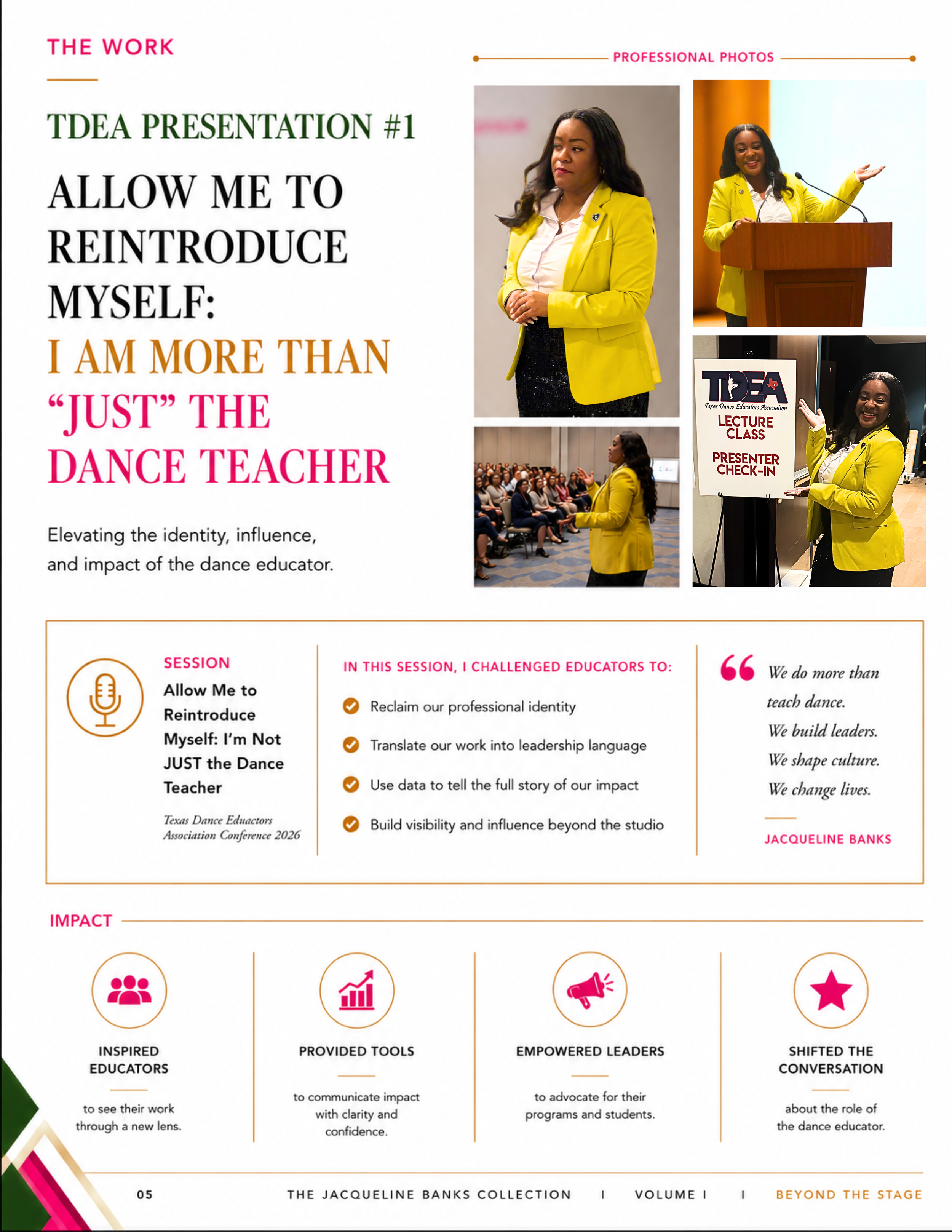
At TDEA, I stood before a room of dance educators and asked a question that was simple on the surface, but deeply personal for many of us:
How are you introduced on your campus?
That question became the foundation of my presentation, Allow Me to Reintroduce Myself. The session invited educators to examine the gap between how their work is described by others and how their work functions in practice. We considered campus introductions, student perspectives, leadership language, and the evidence Fine Arts educators already have but do not always name with precision.
I did not create that session from theory alone.
I created it from more than twenty years in education, from my training as a dancer and scholar at Howard University, from my experience as a professional performer, from my work building programs, leading students, engaging families, developing curriculum, and watching Fine Arts educators carry leadership responsibilities long before anyone gave them leadership language.
I also created it because I know what it feels like to have the work reduced to the smallest possible description.
Dance educators know the feeling.
A campus may celebrate the performance, call on the dancers for school spirit, ask for students to perform at programs, praise the show, applaud the choreography, and still fail to understand the instructional planning, student development, leadership training, family communication, project management, advocacy, and program systems required to make that work possible.
That is the gap.
And the goal is to name the work with the clarity it deserves.
The Gap Between Introduction and Impact
Many Fine Arts educators experience a gap between their campus introduction and their actual influence. The introduction may focus on the class, the performance, the ensemble, or the event. The work itself reaches into instruction, student development, school culture, family connection, and program infrastructure.
That gap matters because support is often tied to how impact is communicated.
A program can be celebrated publicly while still lacking the operational support required to thrive. Leaders may appreciate the performance while having limited visibility into the instructional time, facilities, budget, staffing, scheduling, communication systems, and administrative support that sustain the program.
Language helps make that connection clear.
The National Core Arts Standards organize arts learning around creating, performing or presenting, responding, and connecting. That structure affirms that arts education includes creative development, performance practice, interpretation, reflection, and meaning-making across disciplines.
For dance educators, rehearsal is an instructional space. Choreography includes curriculum design. Team culture reflects student leadership development. Show planning requires project management. Parent communication is family and community relations.
The goal is to name the work with the clarity it deserves.
From Activity Language to Leadership Language
Fine Arts educators often use language that makes perfect sense inside the studio, rehearsal room, stage, or classroom. We talk about rehearsals, formations, transitions, contest prep, costumes, choreography, spacing, stamina, and performance readiness.
That language works inside the discipline. In leadership spaces, the language needs to carry more context.
A dance educator may say, “We have rehearsal.” A leadership-level description would explain that students are developing technical accuracy, ensemble awareness, focus, stamina, artistic interpretation, peer accountability, and performance readiness through guided practice.
A director may say, “We are preparing for spring show.” A leadership-level description would explain that students are participating in a culminating learning experience that includes project management, performance preparation, family engagement, student leadership, technical production, creative expression, and community partnership.
A teacher may say, “We need costumes.” A leadership-level description would explain that performance materials support professionalism, safety, visual unity, cultural context, equitable participation, and the integrity of the artistic work.
This is where language becomes a leadership tool.
It helps principals understand budget requests. It helps district leaders connect Fine Arts to student engagement and school culture. It helps families understand the process behind the performance. It helps communities see Fine Arts as a meaningful part of student development.
In my TDEA presentation, this idea appeared through a practical naming exercise. Common Fine Arts responsibilities such as rehearsals, performances, team culture, choreography, managing dancers, show planning, and parent communication were reframed through leadership language such as instructional planning, community engagement, student leadership development, curriculum design, mentorship and supervision, project management, and family and community relations.
The work is already present. The language makes it clearer.
Data Belongs in the Reintroduction
One of the strongest ideas from the presentation is that data is simply information. For dance educators, data can include attendance at rehearsals and class, enrollment and retention, student grade growth, leadership development, family and community engagement, student reflections, testimonials, and growth stories.
That definition matters because many Fine Arts educators hear the word data and immediately think of test scores or district dashboards. Fine Arts impact can also be documented through participation, persistence, confidence, leadership roles, family turnout, student voice, and program growth.
Research supports the importance of these outcomes. A randomized study of Houston’s Arts Access Initiative found that increased arts education experiences produced positive effects for students, including school engagement, empathy, writing achievement, and reductions in disciplinary infractions.
Social and emotional learning research also gives language to skills often developed in Fine Arts programs. CASEL identifies five connected competencies: self-awareness, self-management, social awareness, relationship skills, and responsible decision-making.
Dance educators teach those skills through daily practice. Students receive correction, manage pressure, adjust to the needs of an ensemble, support younger dancers, reflect on growth, and make choices that affect the group. These are artistic behaviors, and they are also leadership behaviors.
Fine Arts educators need systems for documenting that growth. Attendance, retention, grade improvement, leadership roles, family engagement, student reflections, and community participation can help tell a clearer story about program impact. Organized evidence gives leaders a stronger basis for decisions about staffing, funding, scheduling, facilities, and program support.
The work has heart. It also has evidence.
What School and District Leaders Should Hear
This conversation is for Fine Arts educators, and it is also for the leaders responsible for supporting Fine Arts programs.
The Every Student Succeeds Act recognizes the arts as part of a well-rounded education, and federal arts education resources connect arts access to broader educational opportunity.
That recognition should influence how schools and districts plan for Fine Arts programming. Fine Arts belongs in conversations about instructional quality, staffing, facilities, scheduling, funding, student engagement, family connection, and school culture.
A strong Fine Arts program is an educational asset. It helps students develop skill, identity, discipline, collaboration, confidence, and belonging. It gives families additional points of connection to the school. It contributes to campus pride and community identity. It creates leadership opportunities for students whose strengths may be most visible in creative spaces.
Leaders who understand Fine Arts language are better prepared to support Fine Arts impact.
That support begins with stronger questions:
How are students growing through this program?
What evidence shows engagement, retention, leadership, attendance, and family connection?
What barriers limit student access?
What resources would move the program from survival to sustainability?
How can this program strengthen the larger goals of the campus or district?
Those questions create a more accurate conversation. They also move Fine Arts education from appreciation to infrastructure.
The Reintroduction
The phrase Allow Me to Reintroduce Myself has personality, but it also carries a serious professional charge.
It asks Fine Arts educators to describe their work with accuracy.
It asks school leaders to listen for the leadership embedded in the work.
It asks districts to examine how language, evidence, and support shape opportunity for students.
In the final activity of my TDEA presentation, educators completed this statement:
I am a __________ who leads through __________ and can point to __________.
That sentence asks educators to identify their role, leadership practice, and evidence.
My own reintroduction begins here:
I am Ms. Banks, a Fine Arts curriculum designer, dance educator, speaker, writer, program builder, and educational leader whose work sits at the intersection of artistry, leadership, equity, and school improvement.
I lead through culture, strategy, instruction, systems, and student development. My work has been shaped by public education, strengthened by my training at Howard University, refined through professional performance, and expanded through years of building programs that help students grow as artists, leaders, scholars, and human beings.
I can point to students who found confidence through creative discipline, families who became more connected to school through Fine Arts, programs that gained structure and identity, educators who found stronger language for their work, and communities that saw the arts become a meaningful part of student development and school excellence.
That is my reintroduction.
And it is also an invitation for the field.
Fine Arts educators already carry leadership influence. The next step is naming that influence with enough clarity that schools, districts, and communities know how to support it.
Allow me to reintroduce myself.
And allow the field to be reintroduced too.